
Multiple vendors, venue staff and the client all hold separate versions of the plan

An event usually runs on several documents at once, not one. The caterer has a delivery window in an email thread, the AV supplier has a setup time on a quote, the venue has a load-in slot in its own booking system, and the client is holding a version of the schedule from three revisions ago. None of these parties is wrong — each is working from the last thing they were told.
Poor coordination shows up in the gaps between those versions: a delivery arrives before the loading dock is unlocked, two teams are told they can use the same room at the same time, or setup runs long because nobody flagged that the stage build needed two hours, not one. These aren't planning failures so much as communication failures — the plan existed, it just wasn't shared consistently.
The fix is structural rather than personal: one person owns the master schedule, and everyone else works from a copy of it, not their own record. In practice this means a single coordinator issues one run of show — a timed, sequenced document naming who does what, where, and by when — and updates it centrally whenever something changes, rather than letting each vendor track amendments independently.
Once vendors and staff are working from the same document, most setup errors get caught before doors open rather than after. This is also why communication sits at the top of most role descriptions for the position: it isn't a soft addition to the job, it's the mechanism that prevents the logistics from falling apart in the first place, as the breakdown of core duties on learndirect's overview of the event coordinator role makes clear.
Small logistical details — dietary needs, signage, AV cues — are assumed rather than checked

Small details fail silently because nobody owns checking them — a dietary request sits in a spreadsheet nobody reopens, a directional sign gets printed with the old room number, or a microphone cue is assumed to be "handled" by whoever set it up. None of these is a planning decision anyone consciously got wrong; they're simply items that were never verified against the final schedule.
Attendees don't experience the concept behind an event — they experience whether their sign pointed the right way and whether their food was on the table. A programme can be strong and a partnership well-negotiated, and the event will still be judged a failure if these small mechanics are wrong, because they are the parts a delegate actually touches.
The practical answer is a checklist tied to the run of show rather than a general sense of care. That means:
- Building a list of every detail promised to attendees — dietary flags, accessible seating, signage copy, AV cues — pulled directly from contracts, RSVPs and vendor briefs, not memory.
- Attaching each item to a specific time and person in the run of show, so it has an owner and a checkpoint, not just an intention.
- Walking the checklist physically during rehearsal or setup, when a wrong sign or a missing cue is still cheap to fix.
- Confirming completed items back against the original request, closing the loop rather than assuming delivery.
This is what "attention to detail" means as a working method rather than a trait to claim on a CV — it's a system for catching errors while they're still fixable, not a personality description.
A vendor cancels or equipment fails on event day
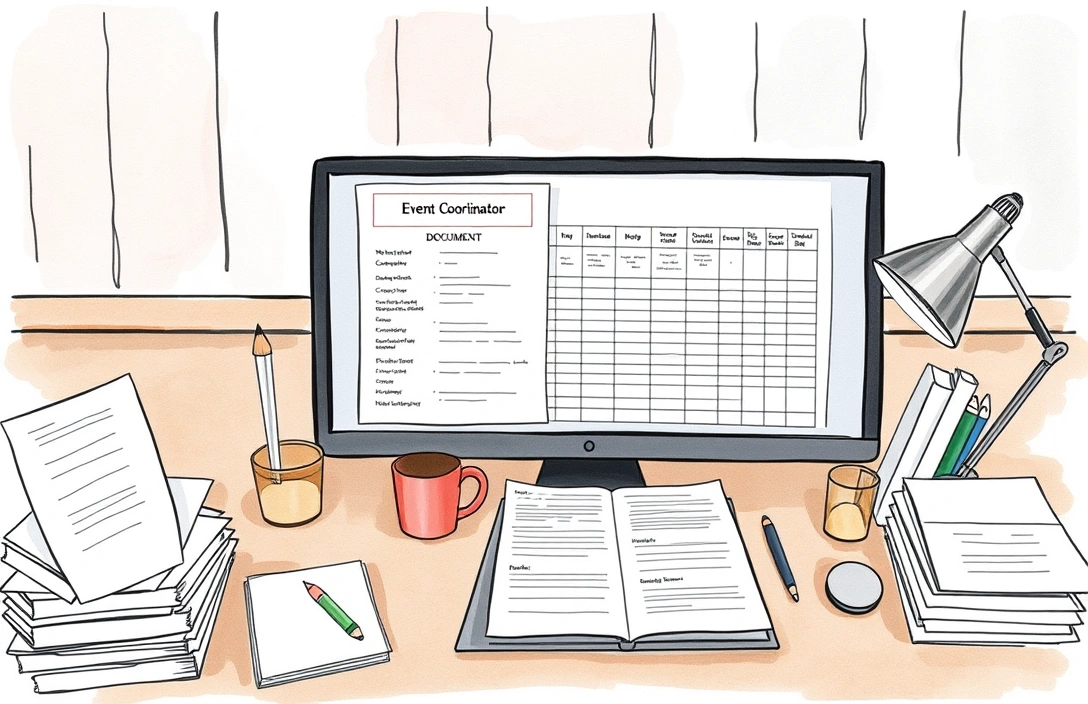
When a vendor cancels or equipment fails, the live schedule starts slipping in real time, and staff look to whoever is holding the run of show for a decision. This is the moment a coordinator's planning either pays off or doesn't — because there usually isn't time to design a fix from scratch once the room is filling.
What actually happens under pressure is substitution: a backup AV supplier is called, a session is reordered so the affected segment moves later, or a contingency script is read while a fix is found off-stage. None of this is improvisation in the pure sense — it's the execution of a plan for failure that was written weeks earlier, alongside the plan for success.
Employers describing a coordinator as someone who "works well under pressure" mean specifically this: the ability to substitute, reorder or delay without the audience seeing the seam. Building that ability in advance means preparing, for each critical vendor and each critical piece of equipment, a named backup and a decision rule for who authorises the switch — problem-solving and contingency planning are listed among the core responsibilities on mediabistro's guide to the event coordinator role precisely because they are treated as a deliverable to prepare, not a trait to hope for.
What is the role of the event coordinator?
The event coordinator is responsible for executing the logistics of an event that someone else — often an event planner or a client — has already designed. That means booking and briefing vendors, building and maintaining the schedule, managing the budget line by line, and being the point of contact on the day when something needs a decision.
The role sits downstream of concept and strategy: the coordinator is rarely the person deciding the theme, audience or objective of the event, but is the person who turns those decisions into a working timeline, a signed vendor contract and a run sheet that staff can follow without asking questions. Duties commonly listed under the title include venue sourcing, vendor coordination, on-site logistics and budget tracking, as summarised in eventespresso's breakdown of the event coordinator job description.
Pay for the role varies by employer and region, but the U.S. Bureau of Labor Statistics groups meeting, convention and event planners together and reports the occupation's national wage data and expected job growth in its Occupational Outlook Handbook entry for meeting, convention, and event planners, which is the most current government source for what the field pays and how it is expected to grow.
Formal schooling isn't a fixed requirement to enter the role. Employers commonly look for a background in hospitality, communications or business, but relevant experience — internships, volunteering on event teams, or coordinating smaller events independently — is frequently accepted in place of a specific degree, and entry routes are described in more detail in learndirect's overview of the role.
Whether the job is stressful depends heavily on scale and mode — a single-track internal meeting and a multi-day conference with parallel vendors carry very different pressure loads — but the job routinely involves tight deadlines, live problem-solving and last-minute changes, which is why resilience and composure under pressure appear consistently across descriptions of the role, including perfectvenue's summary of the skills the role demands.
Event coordinator
The event coordinator is the role responsible for executing an event's logistics: vendors, schedule, budget and on-site delivery. It is the title that appears most consistently across job descriptions and career guides for this line of work, and the one under which most of the responsibilities in this article sit, as reflected in eventespresso's job description breakdown.
Event planner
The event planner is a related but distinct role, focused on the design and strategy of an event rather than its execution — setting the objective, the format, the budget envelope and the overall concept that a coordinator then delivers against. In practice the two titles are frequently used interchangeably, and many job postings and guides blend the responsibilities of both under a single heading, which is worth noticing if a job description reads as strategic in one paragraph and purely logistical in the next — that mixing is common, not a sign of an unusually broad role.
The clearest practical distinction, where employers draw one, is direction of work: a planner typically sets the brief, and a coordinator typically delivers against it, sometimes within the same organisation and sometimes as separate hires entirely.
Event planning
Event planning is the end-to-end process of designing, scheduling and delivering an event — from setting the objective and audience through to budget, venue, vendor selection and the final run of show. It spans both the planner's strategic decisions and the coordinator's execution work, which is one reason the two roles are often described together rather than as a strict hierarchy.
As a process, it typically moves from concept and budget, to venue and vendor contracting, to detailed scheduling, to on-site delivery and post-event review — with each stage constraining the next, so a decision made late (a venue booked without checking AV capacity, for instance) can force costly rework earlier in the chain.
Event management
Event management is the operational oversight of an event's resources, staff and execution once planning decisions have been made. Where event planning asks what the event should be, event management asks how the people, budget and schedule already assigned to it are being run on the day and in the weeks leading up to it — staffing rotas, supplier performance, budget tracking against the original plan, and the escalation path when something needs a decision mid-event.
In smaller organisations this function is often folded into the coordinator's job entirely; in larger ones it can be a separate management layer sitting above several coordinators working different parts of the same event.
Communication skills
Communication is the skill that lets one coordinator keep vendors, venue staff and a client aligned on a single version of the plan, rather than each working from their own. It covers briefing vendors clearly enough that they don't need to guess, updating a client on changes before they're asked, and giving on-site staff instructions specific enough to act on without follow-up questions.
It's named in the majority of role descriptions for the position, not as a general people-skill but as the specific mechanism that prevents the kind of scheduling and delivery failures described earlier in this article — perfectvenue's list of core skills places it alongside organisation and problem-solving as one of the three skills employers screen for most consistently.
To demonstrate it in an interview or on a CV, the strongest evidence is a specific example: naming a moment a schedule change had to be communicated to multiple parties under time pressure, and what was done to make sure nobody worked from an outdated version.
Attention to detail
Attention to detail is the skill of catching a logistical error — a wrong dietary note, a mislabelled sign, a missed AV cue — before it reaches an attendee, rather than after. It's the hardest skill on any list to demonstrate convincingly, because "I'm detail-oriented" is an unfalsifiable claim on its own.
The concrete version of this skill is a checklist practice: pulling every promised detail from contracts and RSVPs into a single list, attaching each to a specific time and owner in the run of show, and walking it during rehearsal rather than trusting memory. Evidence of this skill on a CV or in an interview works best as a specific instance — a case where a checklist walk-through caught an error (a wrong room number on printed signage, for example) with enough time left to correct it before doors opened.
Organisation and time management
Organisation and time management is the skill of sequencing tasks correctly and holding a plan together across a deadline that doesn't move — venue bookings, vendor confirmations, budget sign-off and final headcounts all landing in the right order, not just on time individually. It's what a run of show actually formalises: a single sequenced document that makes dependencies visible, so a coordinator can see that the AV setup has to finish before the rehearsal can start, rather than discovering the clash on the day.
Evidence of this skill is best shown through a specific deadline chain handled correctly — describing a moment where several dependent bookings or confirmations had to land in a fixed order against a fixed date, and how that sequence was tracked and protected.
Vendor management
Vendor management is the work of selecting, briefing and coordinating the outside suppliers an event depends on — caterers, AV companies, décor and staging suppliers, transport providers — and holding each of them to a scope, a delivery window and a budget line agreed in advance. It includes the contingency planning covered earlier: knowing, for each critical vendor, what the backup option is and who has authority to activate it if the primary supplier fails.
Budget management sits inside this responsibility rather than beside it — every vendor contract is a line against a fixed total, and tracking spend against that total as contracts are signed is what prevents a shortfall being discovered only after the event, when nothing can be renegotiated. This combination of vendor coordination and financial tracking is listed as a core duty of the role in both eventespresso's job description and mediabistro's guide to the position.
To build this skill without an existing events job, the accessible starting point is coordinating vendors for a smaller, lower-stakes event — a community fundraiser, a department gathering, a friend's wedding — and keeping the paperwork: the brief given to each supplier, the budget tracked against it, and the outcome. That record is the evidence a hiring manager can ask about directly, which is worth more than a general claim of being good with suppliers.
If you're building toward this role without prior event experience, the fastest way to make any of these seven areas checkable is to run one small event end to end and keep the artefacts — the run of show, the vendor briefs, the checklist, the budget tracker — so the next application or interview has something specific to point to.