
Multiple vendors, venue staff and the client all hold separate versions of the plan

A caterer confirms a delivery window with the venue manager, not the coordinator. The client emails a change to the seating plan directly to the AV supplier, who never passes it on. Each party is working from whatever version of the plan last reached them, and none of those versions match. This is the ordinary condition of event work, not a failure of any one person — it's what happens when a schedule, a floor plan and a set of supplier briefs pass through five or six hands with no single point holding all of them at once.
Poor coordination doesn't announce itself in advance. It shows up as a delivery arriving at the wrong loading bay, two sessions booked into the same room, or a setup crew starting an hour later than the room actually needs them. By the time it's visible, it's usually too late to fix quietly — the fix happens in front of the client or the attendees rather than before they arrive.
The fix is structural rather than personal: one coordinator owns communication and issues a single shared run of show that every vendor, venue contact and internal team member is working from. Cvent's guide to event planning skills lists communication as a core requirement precisely because the coordinator is usually the only person in the chain talking to every other party — the caterer never speaks to the AV team directly, so the coordinator is the translation layer between them. zkipster's list of planner skills makes the same point from the supplier side: vendors need one point of contact who can confirm changes fast, because a vendor acting on a stale instruction is as damaging as one acting on no instruction at all.
Once vendors and staff are working from the same timeline, setup errors get caught during setup rather than during the event. A run of show that lists timings, responsible party and dependencies for each task means a late delivery is spotted against a deadline that's written down somewhere, not discovered when the room is meant to be ready and isn't. This is also why communication sits at the top of most skills lists for the role — not because it's a pleasant trait to have, but because it's the control that catches the largest category of event failures before a guest sees them. Les Roches' breakdown of event management skills places communication among the first skills it names, ahead of most of the technical logistics work — a sequencing that fits the pattern above: the coordination problem is usually upstream of the logistical one.
Small logistical details — dietary needs, signage, AV cues — are assumed rather than checked

A dietary requirement submitted at registration gets logged but never reaches the caterer's final headcount. A directional sign gets printed but not put up because nobody was assigned to do it. A speaker's slide-advance cue gets agreed verbally in a rehearsal that half the AV team missed. None of these are dramatic failures — each is a small thing that someone assumed was someone else's job, or assumed would sort itself out.
Attendees don't experience the concept behind an event; they experience the room, the food, the signage and whether the session started on time. A well-designed programme with a guest who can't eat anything on the buffet, or a delegate who can't find the breakout room, judges the event a failure regardless of how strong the content was. Bravura Technologies' list of skills for event planners names attention to detail as a required skill alongside communication and organisation, but of everything on a typical skills list it's the one most often reduced to a personality claim — "detail-oriented" on a CV — rather than a method a reader could actually copy.
The practical version of attention to detail is a checklist tied to the run of show, not a personality trait applied on the day. Each checklist item is attached to a specific point in the timeline — dietary numbers confirmed with catering a set number of days out, signage placed during setup and checked against the floor plan, AV cues walked through in a full technical rehearsal rather than agreed in conversation. Cvent's list of planning skills recommends building this kind of checklist directly into the planning timeline rather than treating it as a separate document, so a missed item is visible against a deadline rather than discovered only when a guest complains.
The value of this approach is when errors surface. A checklist run during setup or rehearsal catches a missing sign or an unconfirmed dietary count while there's still time to act — printing another sign, calling the caterer, adjusting a seating chart. The same error found once doors are open has no fix available, only damage control.
A vendor cancels or equipment fails on event day
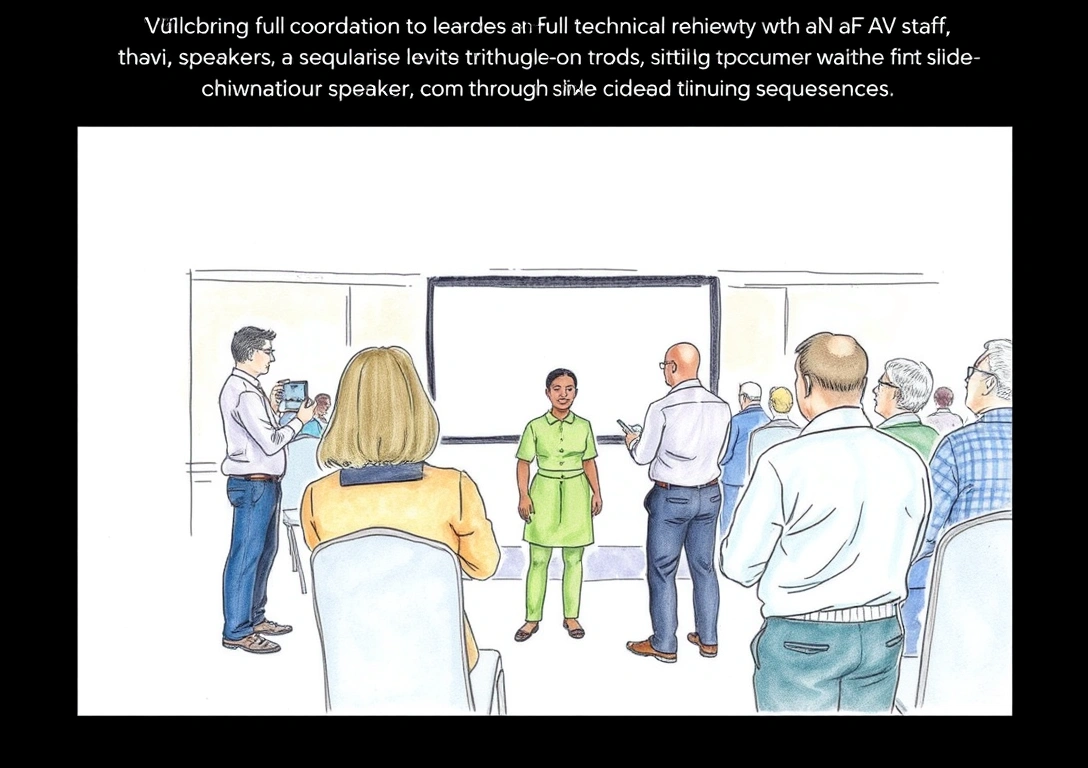
A projector fails ten minutes before a keynote. A catering van breaks down two hours before service. These are not edge cases — they are the ordinary risks of running an event with external suppliers and mechanical equipment, and they happen often enough that most experienced coordinators plan for them rather than hope around them.
When something fails live, the schedule starts slipping immediately, and staff on the ground look to the coordinator for a decision, not a diagnosis. This is the moment "works well under pressure" actually means something specific: not staying calm in the abstract, but having a substitute or a reordered programme already thought through before the failure happens. Perfect Venue's overview of the coordinator role lists problem-solving and contingency planning among the coordinator's core responsibilities rather than personality traits, and the distinction matters: contingency planning is a document you write in advance — a list of backup suppliers, a spare AV kit, a reordered running sequence — not a skill you improvise under stress.
Preparing for this in advance looks like:
- A shortlist of backup vendors for the highest-risk categories (catering, AV, transport), agreed before the event, not sourced during a crisis
- A reordered version of the programme that can absorb a missing session or a delayed start without cancelling anything
- A clear point of decision — usually the coordinator — so staff aren't waiting on a client or committee to approve an obvious call
- A buffer built into the schedule between sessions, so a ten-minute delay doesn't cascade through the rest of the day
The same overview of the coordinator role notes that the attendee experience should absorb the change without visible disruption — the goal isn't a flawless event, since flawless is rarely achievable at scale, but one where the audience never notices the substitution happened. That's the actual test of the skill: not whether something went wrong, but whether the fix was invisible.
Coordinator, planner or manager: which skills belong to which role
The terms "event coordinator" and "event planner" get used interchangeably across most job descriptions and skills guides, which leaves readers unsure which skill set they're actually being told to build. A third term, "event management", gets mixed into the same content without ever being defined separately, which makes the confusion worse rather than better.
Coordinator vs planner
The two roles overlap heavily but aren't identical, and the distinction is mostly about when in the process the work happens and how much strategic authority comes with it.
| Attribute | Event coordinator | Event planner |
|---|---|---|
| Primary focus | Executing the logistics of an already-designed event | Designing the event concept, budget and overall strategy |
| Typical timing | Closer to and during the event itself | Earlier in the process, from concept through to handover |
| Core skills | Communication, attention to detail, vendor liaison, organisation and time management, problem-solving under pressure | Budgeting, negotiation, stakeholder strategy, vendor selection |
| Decision authority | Operational — solves problems within an agreed plan | Strategic — sets the plan, budget and objectives the coordinator will execute against |
| Client contact | Often the day-to-day point of contact once planning is finished | Usually leads the client relationship from the outset |
Withe's event coordinator job description template frames the coordinator as the person who takes an agreed plan and makes sure it happens correctly on the ground — vendor confirmations, timeline management, on-site troubleshooting. Organisation and time management belongs squarely in that list: it's the skill of sequencing every task in the run of show against its deadline and holding that plan as circumstances change, rather than reacting to whatever comes up first. The other skills that matter most for that version of the role are the ones covered above: communication as the control against fragmented information, attention to detail as a checklist discipline, and contingency planning as the answer to live failure.
A planner's role, by contrast, usually starts further back — setting a budget, choosing a venue, negotiating vendor contracts and defining what the event is meant to achieve. In smaller organisations one person often does both jobs under a single title, which is exactly why the skills lists blur together across most sources. The practical answer for a reader deciding which skills to build first is to look at where in the timeline the job actually sits: if the work starts once a concept and budget already exist, it's coordinator skills that matter most; if the job includes setting that concept and budget, planner skills come first.
Where event management fits
Event management sits above both of those job titles rather than alongside them. It describes the operational oversight of an event's resources — budget, staff, suppliers and the schedule that ties them together — rather than any one person's day-to-day task list. Les Roches' breakdown of skills for event management treats the discipline as spanning planning through delivery through post-event review, with coordination as one operational layer inside it rather than a synonym for the whole thing.
The practical difference is scope. A coordinator's work is task-level: confirm the delivery window, walk the AV rehearsal, brief the registration desk. Event management is the layer that decides how many staff are on the ground, what the budget allows for each supplier category, and how resources get reallocated if one part of the plan changes. A single person can hold both layers on a small event; on a larger one, the management layer usually sits with a lead planner or director while one or more coordinators handle the task-level execution underneath them.
The mnemonics searchers ask about
Some searches for this topic look for frameworks like "the 5 C's of an event", "the 7 P's of event management" or "the 5 P's of event planning". These circulate mainly in training content: the 5 C's are commonly given as Concept, Coordination, Control, Culmination and Closeout — a rough map of an event's life cycle rather than a skills list. The 7 P's are usually rendered as Planning, Product, Price, Place, Promotion, People and Process, borrowed loosely from marketing's mix rather than from anything specific to event delivery. A shorter 5 P's version — Planning, Purpose, Presentation, Promotion and Performance — turns up in some course material as a simplified variant of the same idea.
None of these map cleanly onto the actual documents a coordinator produces — a run of show, a vendor list, a budget, a contingency plan — and none of the sources cited throughout this article organise a job description around them. If a mnemonic like this appears in a training course or a template, it's worth treating as a memory aid for the shape of an event rather than a checklist to build a role around.
Demonstrating these skills without an existing events job
Naming a skill on a CV convinces nobody; showing where it was used does. Each of the skills above has a concrete way to demonstrate it even without formal event experience, because each one is really a specific task rather than a trait.
- Communication: point to a time a shared document or single point of contact prevented a misunderstanding between two parties — a course project, a volunteer role, a part-time job with suppliers or customers
- Attention to detail: describe a checklist built for a task with multiple moving parts and dependencies, and what it caught before it became a problem
- Organisation and time management: describe a schedule or timeline built for a multi-step task, and a point where a deadline slipped and had to be re-sequenced without dropping anything downstream
- Vendor management: describe comparing two or more suppliers against the same criteria — price, reliability, lead time — and the reasoning behind the choice, even for something as small as booking a venue for a small society event
- Contingency planning: describe a backup plan built in advance for something with a real chance of failing, and what happened when it was actually needed
- Working under pressure: describe a specific moment something went wrong on a live timeline and what the immediate decision was, not just that the outcome was fine
zkipster's skills guide and Cvent's list of planning skills both frame these as skills built through repeated small-scale practice — running a student society event, organising a family gathering with multiple suppliers, or volunteering at a larger event under someone else's coordination — rather than skills that require a paid events job first. The evidence an interviewer is looking for isn't the scale of the event; it's whether the candidate can describe a specific decision, a specific checklist, or a specific fix, rather than a general claim to be "organised" or to "work well under pressure."
Budget management and the run of show belong in this list too, even though most skills pages leave them off. Being able to say how a budget was tracked against actuals, or how a running schedule was built and adjusted on the day, is a more concrete claim than "good with numbers" or "organised" — and it's the kind of detail that separates a candidate who has actually built these documents from one who has only heard the terms.
Start building a portfolio of these examples now, even from small or informal events, so each skill has a real situation behind it rather than a bare adjective on a CV.